Monday, February 28, 2011

Activity Card, Part 2

Now for some serious PROBLEM SOLVING.
  The Activity Card is divided into two parts, the first one is an experiment and the other is pure solving.
Now, to prove what you have learned over the past lessons. Kindly answer the following questions, and see how you have learned so far! 
Questions:
1. A balloon contains 0.1 moles of oxygen and 0.4 moles of nitrogen. If the balloon is at standard temperature and pressure, what is the partial pressure of the nitrogen?
2. A gas in a cylinder occupies a volume of 0.065 m3 at room temperature (T = 293 K). The gas is confined by a piston with a weight of 100 N and an area of 0.65 m2. The pressure above the piston is atmospheric pressure.
(a) What is the pressure of the gas? 
(b) The gas is heated, expanding it and moving the piston up. If the volume occupied by the gas doubles, how much work has the gas done?
(c) What is the final temperature of the gas?

Activity Card, Part 1

Lab Experiments Are FUN!
  The Activity Card is divided into two parts, the first one is an experiment and the other is pure solving.

Cloud Machine

Description: Observe cloud formation when a gas is allowed to expand quickly in volume.
Required Equipments: Pressure Pumper, match, Empty 20oz or half-liter soda bottle
Procedure:
1. Add a little water to a 20-oz. pop bottle.
2. Light a match and blow it out. Hold it inside the mouth of the bottle and let some of the smoke go in the bottle.
3. Put the Pressure Pumper on top of the bottle.
4. Pump the Pressure Pumper 100 times. What is happening to the pressure inside the bottle?
5. Release the pressure by slowly unscrewing the Pressure Pumper. Carefully watch the air inside the bottle. What happens?
 
Additional Questions:
1. What happens to water vapor as it cools?
2. What is the purpose of the smoke?
3. Why does fog form more often in the early morning than any other time?

Guide Card, Part 7

ONLINE WATCHING IS GOOD!

Here are some YouTube Videos that explains further what PRESSURE really is.


Sunday, February 27, 2011

Guide Card, Part 6

Pascal's Principle

Pressure is transmitted undiminished in an enclosed static fluid.

 
Any externally applied pressure is transmitted to all parts of the enclosed fluid, making possible a large multiplication of force (hydraulic press principle). The pressure at the bottom of the jug is equal to the externally applied pressure on the top of the fluid plus the static fluid pressure from the weight of the liquid. 

Guide Card, Part 5

Fluid Kinetic Energy

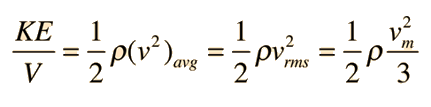
The kinetic energy of a moving fluid is more useful in applications like the Bernoulli equation when it is expressed as kinetic energy per unit volume 


When the kinetic energy is that of fluid under conditions of laminar flow through a tube, one must take into account the velocity profile to evaluate the kinetic energy. Across the cross-section of flow, the kinetic energy must be calculated using the average of the velocity squared , which is not the same as squaring the average velocity. Expressed in terms of the maximum velocity vm at the center of the flow, the kinetic energy is
 

Fluid Potential Energy

The potential energy of a moving fluid is more useful in applications like the Bernoulli equation when is expressed as potential energy per unit volume 


The energy density of a fluid can be expressed in terms of this potential energy density along with kinetic energy density and fluid pressure.

Saturday, February 26, 2011

Guide Card, Part 4

The Pressure Calculation

There are many physical situations where pressure is the most important variable. If you are peeling an apple, then pressure is the key variable: if the knife is sharp, then the area of contact is small and you can peel with less force exerted on the blade. If you must get an injection, then pressure is the most important variable in getting the needle through your skin: it is better to have a sharp needle than a dull one since the smaller area of contact implies that less force is required to push the needle through the skin.

When you deal with the pressure of a liquid at rest, the medium is treated as a continuous distribution of matter. But when you deal with a gas pressure, it must be approached as an average pressure from molecular collisions with the walls.

Pressure in a fluid can be seen to be a measure of energy per unit volume by means of the definition of work. This energy is related to other forms of fluid energy by the Bernoulli equation.


Guide Card, Part 3

"Pressured" Units

Since 1 Pa is a small pressure unit, the unit hectoPascal (hPa) is widely used, especially in meteorology. The unit kiloPascal (kPa) is commonly used design of technical applications like HVAC systems, piping systems and similar.
  • 1 hectoPascal = 100 Pascal = 1 millibar
  • 1 kiloPascal = 1000 Pascal

Some Pressure Levels

  • 10 Pa - the pressure below 1 mm of water
  • 1 kPa - approximately the pressure exerted by a 10 g of mass on a 1 cm2 area
  • 10 kPa - the pressure below 1 m of water, or the drop in air pressure when moving from sea level to 1000 m elevation
  • 10 MPa - nozzle pressure in a "high pressure" washer
  • 10 GPa - pressure enough to form diamonds

Some Alternative Units of Pressure

  • 1 bar - 100,000 Pa
  • 1 millibar - 100 Pa
  • 1 atmosphere - 101,325 Pa
  • 1 mm Hg - 133 Pa
  • 1 inch Hg - 3,386 Pa
A torr (torr) is named after Torricelli and is the pressure produced by a column of mercury 1 mm high - equals to 1 / 760th of an atmosphere.
  • 1 atm = 760 torr = 14.696 psi
Pounds per square inch (psi) was common in U.K. but has now been replaced in almost every country except in the U.S. by the SI units. Since atmospheric pressure is 14.696 psi - a column of air on a area of one square inch area from the Earth's surface to the space - weights 14.696 pounds.

The bar (bar) is common in the industry. One bar is 100,000 Pa, and for most practical purposes can be approximated to one atmosphere even if
1 Bar = 0.9869 atm
There are 1,000 millibar (mbar) in one bar, a unit common in meteorology.
1 millibar = 0.001 bar = 0.750 torr = 100 Pa
Source: http://www.engineeringtoolbox.com/pressure-d_587.html